
Appearance
Sourcemaps
A minified frame reading nitro.mjs:6416 tells you nothing. The whole point of this module is that the frame instead reads server/api/orders.ts:42 with the failing line shown around it — and it manages that without an upload step, because it runs on the machine that holds the maps.
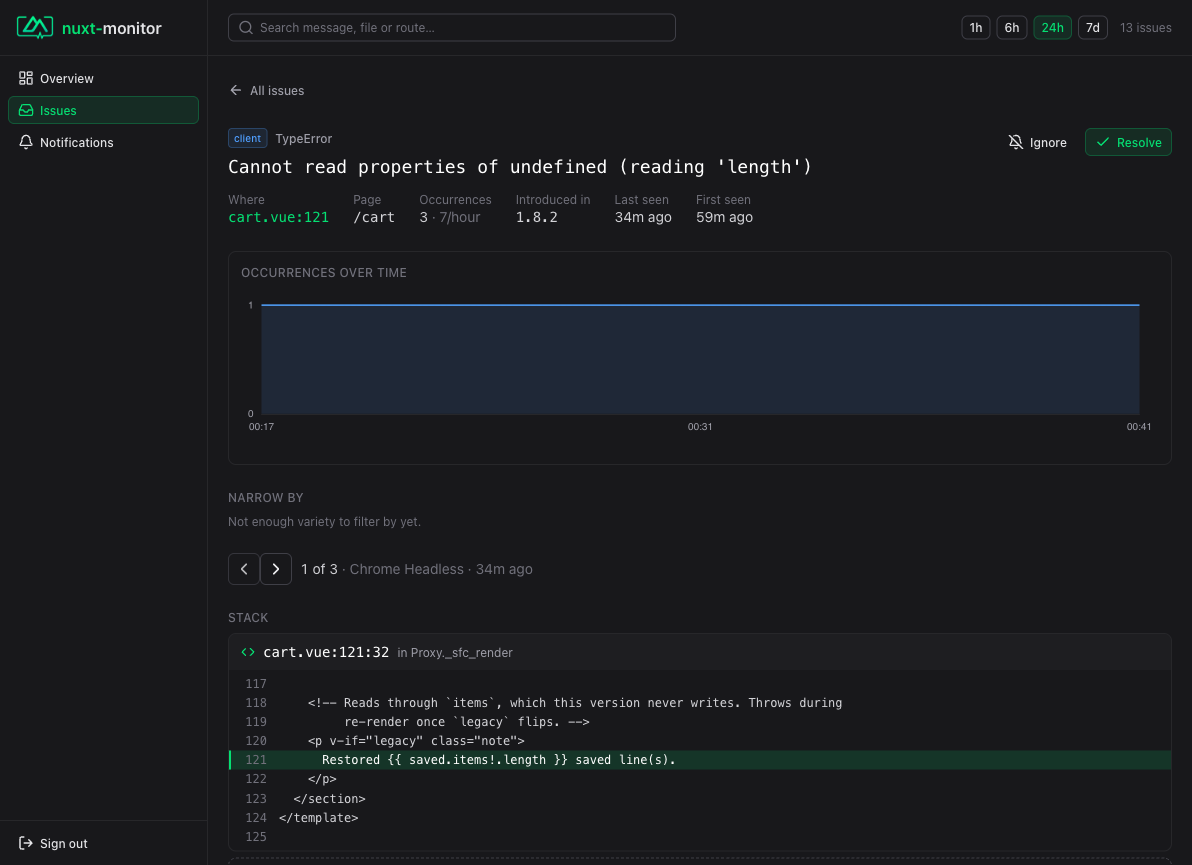
Framework frames are folded away, because they are never what you are looking for.
How it works
Maps are read from disk at the moment you open an issue, not at capture time. An error storm would otherwise turn into a burst of map parsing on the request path.
Client maps are generated as sourcemap.client: 'hidden' — the files are written but no sourceMappingURL comment points at them — and then moved out of the public directory into .output/monitor/maps after the build. 'hidden' alone is not enough: Nitro would still serve the .map file to anyone who guessed its name.
Server maps sit beside their code in .output/server, and need two settings that the module applies for you. Each fails silently on its own:
sourcemap.serverdefaults tofalse, so no usable map is written.- Nitro's
sourcemapMinifyblanks themappingsof any map whosesourcesmentionnode_modules— a reasonable size optimisation when nobody reads the maps. But the server bundle mixes your handlers with vendor code in one chunk, so the rule catches your code too. The.mapstill exists and still names your files, which is what makes it so quiet: the resolver finds a map, parses it happily, and getsnullfor every position.
Both are only set when you have not said otherwise, so opting back into smaller maps stays possible.
Across deploys
A deploy replaces the build output, and with it the maps that explain the traces still arriving from the version being replaced. That is exactly the window where you need them.
So every build files a copy of its maps beside the database, under an id derived from what it produced:
.monitor/
  monitor.db
  maps/
    90d1cd9e2f3d/
    1366f5a7c0c7/
    …
Resolution searches the running build first, then every archived one. That is safe because asset names carry a content hash — eH5xbD7-.js names one build's output and nothing else — and it is why the archive is keyed by build rather than by release. A release name is reused across rebuilds, so keying by it meant one build deleted another's maps.
keepSourcemapBuilds bounds the archive at five builds. Map resolution does not need release set; a release is still worth setting, since it tells you when something started.
In development
There are no maps on disk in dev — Vite serves each module transformed with its map inlined as a base64 comment, and the browser reports frames against exactly those URLs. So the module fetches the module back from the dev server it came from and reads the inlined map.
Fetching is restricted to loopback addresses and to the /_nuxt/ path Vite serves modules under. Client stacks arrive through an endpoint that needs no credentials, so an unchecked fetch here would be a request to any address the process can reach, chosen by whoever posted the stack.
When that fetch comes back empty the archive is still searched. A dev server reads the same database as the production build beside it, so its dashboard often shows issues from another process entirely — frames naming assets Vite never served, whose maps are on disk in the archive.
Server-side traces in dev
Server frames from a dev server resolve less reliably: Vite serves only the client transform over HTTP. Production server traces resolve properly.
When a frame does not resolve
The dashboard distinguishes two failures, because they send you to different places:
no map— no sourcemap for that file was found anywhere. The event almost always came from a build this process cannot see.unmapped— a map was found and read, and it covers no position at that point. Ordinary for a frame inside vendor code.
In both cases the line number shown counts lines in the built bundle, not in the file named beside it.
They are never published
Two things keep the maps private:
'hidden'leaves nosourceMappingURLcomment in the served bundle, so nothing points a browser at them.- They are moved out of the public directory before the manifest is built, so requesting one is a plain
404rather than an error that would confirm the file once existed.
Untrusted frames
A client stack names a file, and that name is chosen by whoever posted it. Client frames may therefore only resolve against the published build assets — never an arbitrary path on disk.
Server frames — which this process produced itself — are the only ones allowed to name absolute paths. The same containment applies to the sources a map points at, so a map cannot lead a client frame outside its own directory.